


The latest development in the Emmanuel Clase pitch-rigging scandal makes the disturbing case more concrete. Federal prosecutors have now identified 18 pitches, thrown across 17 games from May 2023 through May 2025, at the center of their case against the Cleveland Guardians closer.
Clase pled not guilty, and that matters. These remain allegations until they are proven in court. Still, fans cannot ignore details that challenge their faith in the sport and everyone entrusted to protect its integrity.
According to ESPN, the list includes Clase’s first pitch to Detroit’s Matt Vierling in the ninth inning of Game 1 of the 2024 American League Division Series. It was a 93-mph slider taken for a ball. Cleveland won 7-0, but that is hardly the point. A postseason pitch appearing in a gambling prosecution strikes at the trust that makes competition meaningful.
The government says it will try to prove that Clase gave bettors advance information about at least one of those 18 pitches, allowing wagers on details such as location, result or velocity. The filing narrows the pitches prosecutors intend to prove at trial.
Clase’s former teammate Luis Ortiz is also accused of supplying advance information on two pitches. Prosecutors allege that the operation produced more than $460,000 for bettors, with approximately $400,000 connected to Clase’s pitches and another $60,000 connected to Ortiz. The charges include fraud, sports-bribery and money-laundering conspiracies.
The trial is scheduled to begin with jury selection Nov. 2 in Brooklyn. A judge rejected requests for separate trials, so Clase and Ortiz are expected to be tried together. Both men have pleaded not guilty, and Clase’s defense has argued that investigators misunderstood messages concerning cockfighting, which is legal in the Dominican Republic, for coded pitch references.
Prosecutors tell a very different story. They allege Clase sometimes arranged to throw a ball, frequently in the dirt, or deliver a pitch below his normal velocity after bettors had been tipped off. The original Justice Department announcement said he supplied wager money and received bribes or kickbacks. Prosecutors also claim he later told Ortiz to describe a roughly $5,000 payment as money for a horse.
Evidence—not outrage—must determine guilt in court. Clase and Ortiz deserve the presumption of innocence, as all defendants do. Fans should resist declaring a verdict before jurors examine the evidence. But reserving judgment does not make the allegations minor.
If they are proven, this would not be a harmless wager, an isolated lapse in judgment or a technical violation buried in baseball’s rulebook. Intentionally manipulating even one pitch for gambling purposes would mean turning a real major-league game into a private financial arrangement. It would betray teammates, fans and opponents who believed the competition was legitimate.
That concern deepens because young fans are watching. Children do not see an All-Star closer merely as an employee performing a specialized job. They see the entrance music, the saves and the celebrations. They wear the jersey, copy the delivery and imagine holding the game.
That spotlight creates responsibility. Cheating for any reason is a horrible idea, whether the motive is betting, money, competitive advantage, personal pressure or helping somebody else profit. An athlete cannot accept that influence while acting as though his decisions affect only him. Kids absorb what their heroes normalize.
It would be dangerous to say manipulating one pitch is acceptable because the team still won, the batter did not reach base or the game’s final score was unaffected. Integrity is not measured by the scoreboard alone. Secretly predetermine any action and the public is no longer watching honest competition. Just one pitch is one too many.
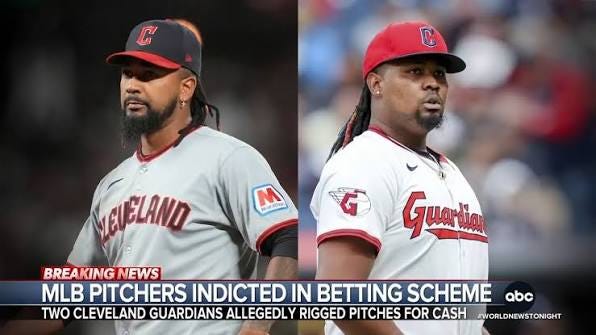
The timing also hurts Cleveland. Cleveland finished the weekend at 76-74, only a half-game behind the Chicago White Sox in the American League Central, despite ranking near the bottom of MLB in runs and slugging percentage. This should be about a resilient club fighting for October. Instead, one of the franchise’s most recognizable names is again making news because prosecutors have made their accusations more specific.
Clase and Ortiz have not pitched since the first half of 2025 and remain away from the club. For the Guardians, the practical challenge is to keep this case from overwhelming players who had nothing to do with it. MLB’s broader challenge is protecting games from micro-betting markets that can turn one pitch into a lucrative target.
No policy can eliminate every bad decision, but MLB must continue monitoring unusual wagering patterns, sharing information with sportsbooks and educating players about the consequences. The investigation reportedly began after sportsbooks flagged suspicious betting on specific Ortiz pitches in June 2025, showing that detection systems can work. They must also protect players from unsupported suspicion.
Here’s the thing, folks: Clase will have his opportunity to defend himself in November, and the legal process must work. If he is cleared, that outcome must be respected. If proven, punishment should reflect more than the money involved or the number of pitches identified.
With that . . . It should reflect the damage done to baseball’s credibility and to the example set for children who believed a star closer was showing them how the game should be played. Kids deserve better.
When you do not play with them, root for them until they are proven guilty.
Please visit Binary News where we post regular opinion pieces about including but not limited to business, politics, sports, and technology.